Stability – The Foundation for the Intercultural Woman
What is one important part of yoga that we often overlook, yet long for, especially in a world that feels uncertain, fast, and experiences chaos?
Stability.
As an intercultural woman, you may know instability more intimately than most. Whether through migration, motherhood, cultural shifts, or inner transitions—you’ve likely learned how to keep going, adapting, adjusting. But what if, instead of constantly adjusting to your environment, you could anchor within?
Let’s take a closer look at what stability really means.
Stability: More Than Stillness
Stability (n.):
The strength to stand or endure.
The ability to return to equilibrium after being disturbed.
Resistance to disintegration.
Firmness.
When you reflect on this, you’ll see that stability isn’t simply stillness.
It’s a dynamic process of returning to center again and again.
Which brings up a powerful question that only you can answer in your own body, on your own mat:
What is that center?
How is that present for you?
What does it feel like, or even look like?
Stability Is Not Rigidity
In a recent blog post, yoga educator Jenni Rawlings reminds us that stability is not the same as rigidity. In fact, true stability includes movement. It’s the ability to respond, adapt, and return to center — not to freeze into perfection.
She breaks it down into three layers:
- Mechanical stability – the physical arrangement of body parts in space.
- Neuromuscular stability – your body’s ability to control that arrangement through muscle activation and nervous system support.
- Perceived stability – your felt sense of balance and inner steadiness.
This reframe is essential for women who live in-between: between cultures, between expectations, between languages or worldviews. Your life already holds motion. So your yoga doesn’t have to be about stillness, but about stabilizing within the movement.
Kaya Sthairyam: The Yogic Foundation
In Hatha Yoga, this concept is embodied through Kaya Sthairyam — the steadiness and relaxation of the physical body.
Without it, your practice becomes scattered, reactive, or driven by fleeting sensations:
“What do I need in this moment?”
“Maybe I should just do this pose instead…”
“My body feels tight—let me escape this discomfort.”
This isn’t judgment. It’s an invitation.
To build a different kind of steadiness—one that grounds you through presence rather than performance.
Life’s Demands vs. Your Roots
So how does this quality carry into your daily life?
A life that, especially for women crossing cultures or caring for families, is full of pulls:
“Get things done.”
”Go out and explore. Make new friends.”
”Don’t feel lonely.”
“Respond now.”
“Be productive.”
“Give your children every experience. Don’t let them miss out.”
“Adapt. Fit in. Be successful.”
All of this… while trying to stay connected to yourself.
The Bhagavad Gita offers another path.
The Bhagavad Gita on Stability
This sacred yogic text teaches us that true stability is spiritual and internal:
- Emotional balance comes from not clinging to success or failure. Knowing and holding onto your purpose.
- Stability grows from understanding your true Self—beyond body, identity, and circumstances. It is something unchanging, eternal.
- And a steady mind isn’t passive—it’s disciplined, awake, and free from reactivity.
You can act without attaching to the outcome—allowing peace to arise even amidst uncertainty.
These are teachings to return to again and again. In fact, you would like to embody them.
A Tree as Your Teacher
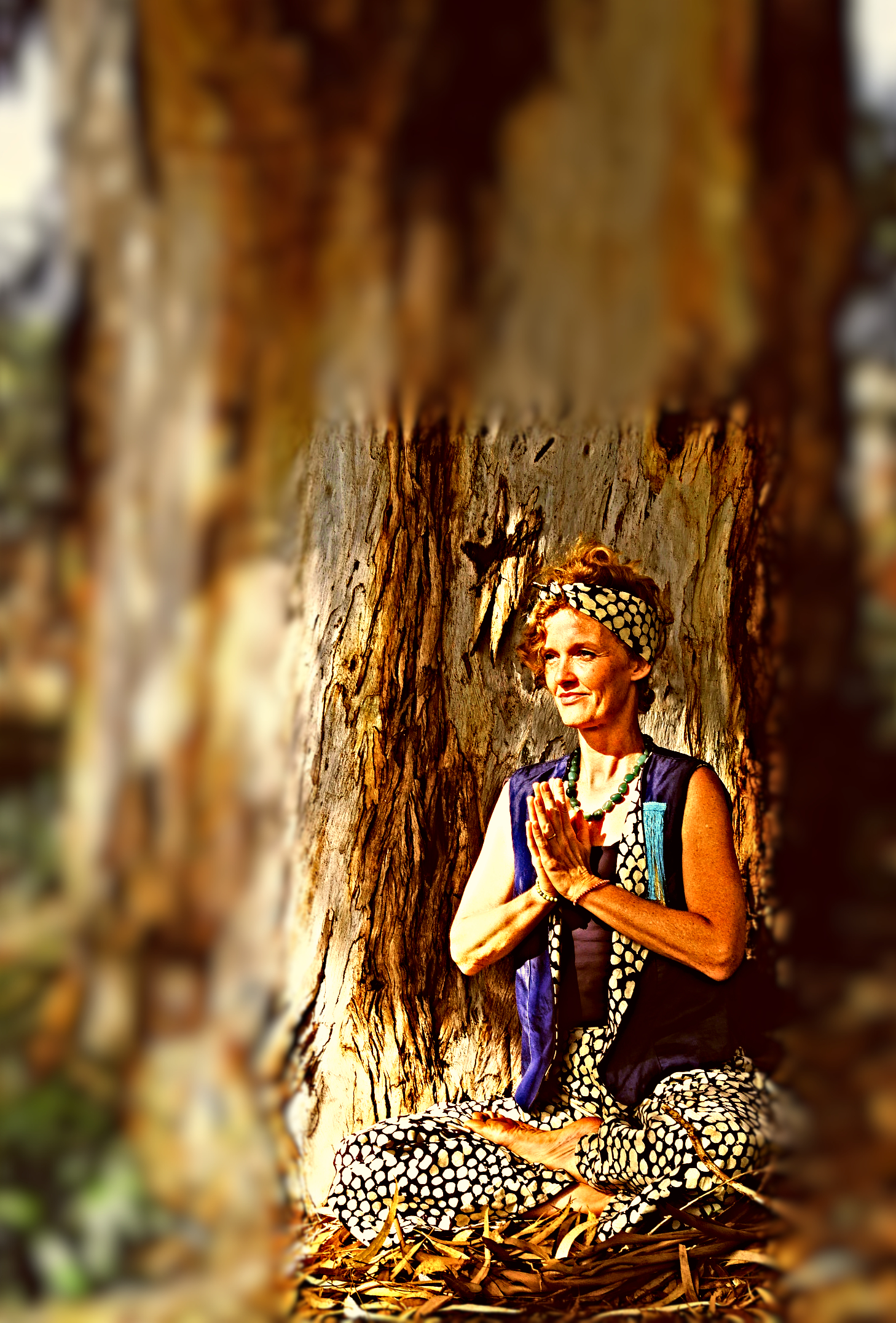
Take a moment—now, if you can—to look at a tree.
Feel its roots, grounding deep into the unseen. Its branches open, dancing with the wind. Its stillness is not the absence of movement—but the presence of connection.
Stand like a tree.
Plant your feet.
Let your arms move like branches, gently or boldly, depending on the wind—your breath.
Listen to the rustling leaves.
Feel the melodies of life.
Let your breath move with the winds around you. No matter in which country you are.
When the world around you becomes destabilized—when systems, relationships, or even your own identity feel shaken—you don’t have to lose yourself in the storm.
You can return to your roots.
You Don’t Have to Wait
You don’t have to wait for someone else to offer you stability.
You can create it.
You can build it in your body.
You can take the time for it.
You can let it rise from your breath, your rituals, your knowing.
And when you take the time to sit still—eyes closed, breath deep, mind centered—it may seem to the world that you are doing nothing.
But in truth?
You’re doing the most powerful thing there is:
You’re laying the foundation of your Self.
You’re paving the way for seeking the meaning to the existence of life.
Closing Reflection
So remind yourself of this —
next time you step on the mat,
next time you feel ungrounded,
next time you hear a voice (your own or someone else’s) saying,
“There’s still so much to do.”
Come back to your breath.
To your roots.
To your steady, spacious Self.
This is the yoga of the intercultural woman—rooted in motion, stable in transformation.