From Florence to Ngorongoro: why your yoga mat can be the first place you call home.
“Mama, these aren’t shops, they are sheds…” And to be honest, that was one of my first thoughts when we drove through Tanzania and arrived in our new village almost three years ago.
You can probably imagine the beautiful streets and scenery of Florence – yup, that’s where we lived before – and then we moved to this relatively big, remote village near Ngorongoro, one of UNESCO’s World Heritage Sites. We had to explain that these ‘sheds’ are really shops for the locals and that’s how they earn their income. After a while, we got used to the shops (although not completely). We even found a sports shop and guess what it had? A big, thick foam mat that I could buy to put under my very thin yoga travel mat. My husband really encouraged me to get it, because he knew how difficult it was to pack up my beautiful cork/recycled‑plastic yoga mats that are currently in storage in Milan. But I know, one day, we will be reunited.
Anyhow, back at our bungalow, which was probably an eighth of the house we lived in in Italy, I had to find my space in the house where I could practice and teach yoga. A space where I wouldn’t be disturbed, where the internet would reach and work, where my family wouldn’t hear me chanting all my mantras or say things to my yoga students that sound like abracadabra to them.
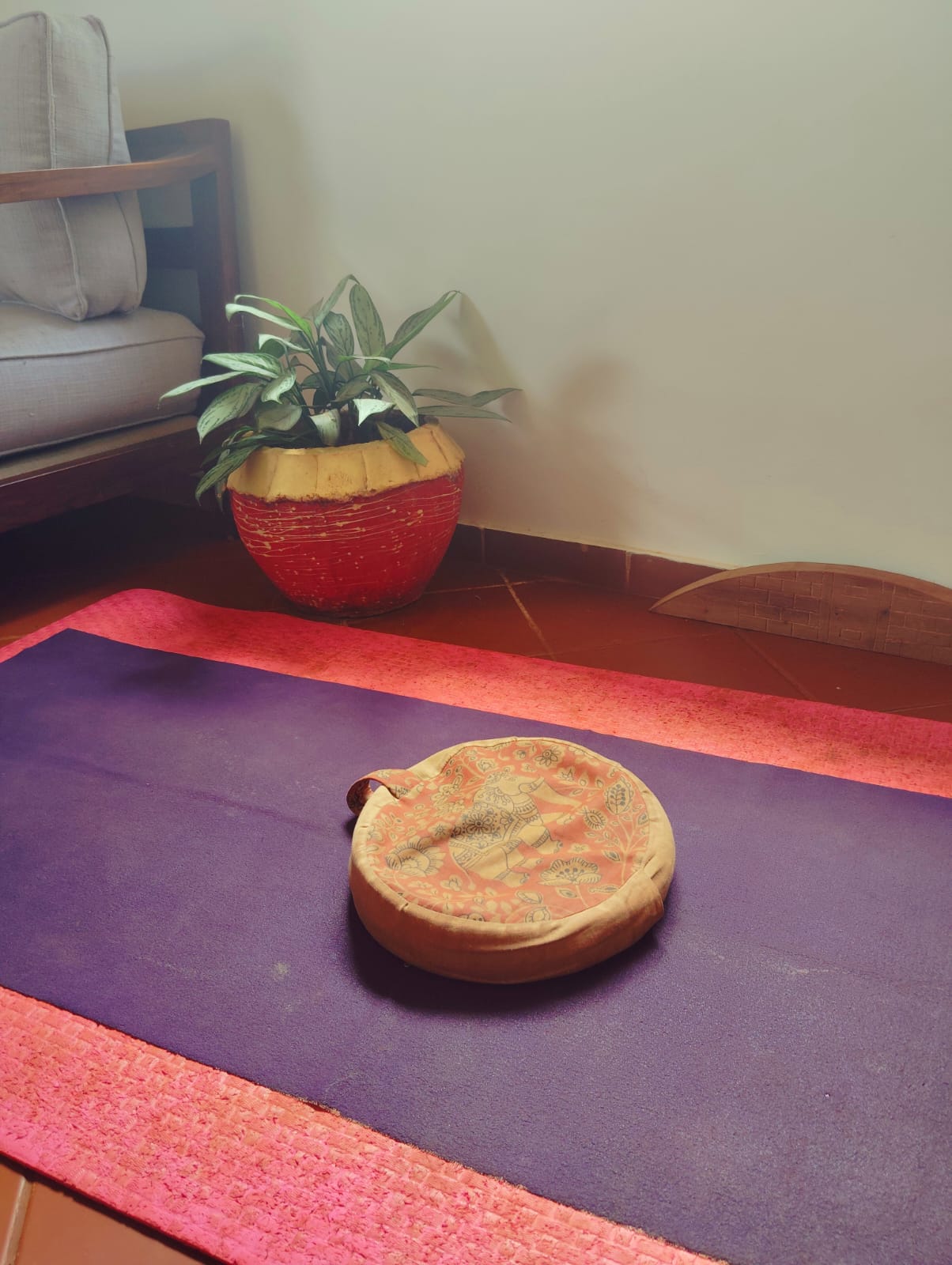
Well, I ended up finding a ‘cozy’ corner in the living room (do the maths…it only ticks one box from the conditions – internet), where I could roll out this big, funky pink mat with mud stains at the back and put my thin purple yoga mat on top of it – perfect colour combination, very calming…
And you know how in some countries it’s sacred to take off your shoes… Well, my mat gets to see all the dirt we bring into the house, despite shoes left outside. And did you know my cat loves to eat her fish on my mat in the morning?
Anyway, some of you know the spot and my mats, because it’s precisely that space you see when we meet online for our practices and conversations. My living room functions as my office and yoga studio. Oh, and it’s the place where we eat, play games, lounge on the sofa, run after the cat, and put all our stuff.
Yet my special corner, despite it (and me) being very visible, is the space where I can land the most. Ideally, we would like to be in a state of Drashta (a neutral observer without any judgments), a physical body that doesn’t absorb, deep breathing from the navel and that you don’t have to land at that ‘perfect’ spot because you feel landed all the time. Over time, I have realised that is probably only available for a few and mainly for the ones living in an ashram, completely devoted to practicing and teaching without any direct disturbances.
Anyhow, when you can create a special space in your house, even if you have to roll up your yoga mat and put it away, that space starts getting the energy of devoted practice. It becomes something inside of you that knows it’s a place you can return to any time, where you can create safety, where you can sit to process all the challenges and emotions. It’s your corner, your mat.
Maybe this is where something quietly shifts, especially if you have been holding on to the idea that your practice (or starting a practice) needs the right conditions to be valid. Somewhere along the way, many of us began to believe that yoga requires a certain kind of space – clean, quiet, beautifully curated, almost untouched by real life. A space where nothing interrupts, where the light falls softly, where the mat is rolled out not just for practice, but almost for display. I have to admit, those spaces are wonderful to be at. But when you find yourself in a place where none of these conditions are available, something else begins to reveal itself.
Because what is being challenged is not just your environment, but your relationship to control and to understanding what yoga is actually about. The subtle expectation that you, as a practitioner or even me as a teacher, should be able to create a contained experience, one that looks and feels like yoga is “supposed” to look.
To be honest with you, I sometimes don’t share everything I would like to during a class, simply because of my environment. That’s one of my personal lessons and challenges. What do I stand for? What is yoga teaching me? How do I express myself regardless of judgment that may come? So my special corner in my living room should remind you that yoga is real life and that we find ways together to move through that.
This doesn’t look anything like the yoga life I once imagined.
Not when I first stepped onto a mat back in 2012, slowly beginning to understand what it meant to be with my body in a more attentive way, let alone explore my breath capacity. Not when I started teaching in 2018, holding space for others in environments that, at least on the surface, seemed to support that role with a certain ease and structure. And certainly not in those earlier years where the quiet, the space, and the relative order of things created a kind of external steadiness I was perhaps leaning on.
Because when you are surrounded by calm, it is very easy to believe the calm is coming from within you. It takes time, sometimes years, sometimes a complete shift of environment, to begin to discern the difference. Living here in Tanzania did not teach me that yoga happens on the inside, because I knew that already. It revealed to me, in a way that was much harder to ignore, whether that understanding had truly taken root.
All the external conditions that had, in some subtle way, been supporting my practice – space, a type of silence, predictability, even a certain aesthetic sense of order – were no longer consistently available. Instead, there was movement, unpredictability, a constant negotiation of shared space, sounds that didn’t fade into the background, and a rhythm of life that asked for far more flexibility than control. Some might even remember that during my first year in Tanzania, I had to pick up my laptop when teaching because I was being ‘attacked’ by insects.
But I kept returning to this small space where a bright pink foam mat met a thin purple travel mat, layered not out of preference but out of necessity, because even my garden couldn’t create the safety I needed, knowing that a leopard was walking around in the village.
And so, coming back to a space you have created, despite its imperfections, begins to create its own kind of structure. The body starts to recognise the act of arriving. The breath adjusts before it is consciously guided. The mind, even if only slightly, begins to soften into something that feels familiar. What I began to notice, more and more clearly, is that the mat itself – this simple, layered, slightly absurd setup – was no longer just something I used to practice on; it had become somewhere I returned to, in a way that felt far less physical than I once understood.
For many of the women I work with, especially those who have also crossed borders in one way or another, there is often this quiet search for the “right” conditions to begin (again). But life doesn’t wait. There’s always something that requires your attention, something that needs adjusting, something that isn’t quite in place yet. Life unfolds in the middle of the noise, the uncertainty, the half‑finished routines, the unfamiliar environments, and the subtle sense of being between worlds.
So ask yourself, “What would happen if I actually begin yoga exactly where I am?” Doesn’t that stimulate a relief? Know that yoga does not deepen when everything aligns externally. It deepens when your relationship to what is present begins to change.
- When you stop waiting for silence and learn how to listen within noise.
- When you stop seeking spaciousness outside and begin to notice the small moments of space that already exist within you.
- When you realise that control was never the foundation you thought it was.
And perhaps most unexpectedly, there is also an emotional layer to all of this that is easy to overlook. Moving, especially across countries and cultures, asks something of you that is not always visible on the surface. There is a constant recalibration happening. A quiet processing of what feels familiar and what doesn’t. A subtle, and sometimes not so subtle, sense of displacement that can arise even in places that are objectively beautiful, even in the third year of living in that country.
In those moments, the practice becomes something more than just movement or breath. It becomes a place where you can sit with the parts of yourself that are still adjusting. Where you can meet the discomfort of not fully belonging yet, without needing to immediately resolve it. Where you can begin to create a sense of steadiness that is not dependent on your surroundings catching up with you.
For me, that corner of the living room, with all its imperfections, became exactly that. And perhaps that is when the meaning of “home” begins to shift, especially when your life stretches across places, cultures, and versions of who you once were. Home, in that sense, is no longer something you can rely on externally. It becomes something far more subtle and far more essential, something you build in small, almost invisible ways. For me, it is in the repeated act of stepping onto that mat, into that imperfect, shared, very ordinary corner of the living room, that I began to understand this is where I could settle into the feeling of being at home. Not because of where it is placed or how it looks, but because it is the one space where I can return to myself without needing anything around me to make sense first. A place that doesn’t ask me to have fully arrived, but simply to be willing to land, again and again, exactly as I am.